Who can choose where AI processes information?
In January 2024, a question in Singapore's Parliament asked about the private firms and foreign jurisdictions involved when government agencies use AI. The question points to a practical purchasing problem. A supplier may offer local data storage while processing prompts and responses elsewhere.
The study followed the options published by OpenAI, AWS, Microsoft Azure and Google across 195 countries. The country, model and purchasing plan often changed the answer. Some suppliers offered local storage without local inference processing. Others offered a national processing route only for particular models or buying arrangements.
A narrow map of documented choices
The original survey checked published options across 195 countries using a fixed supplier catalogue dated 5 October 2026. Under a strict national-processing criterion, 19 countries had at least one qualifying option. The count increased to 42 when the rule also admitted documented processing zones that span multiple countries.
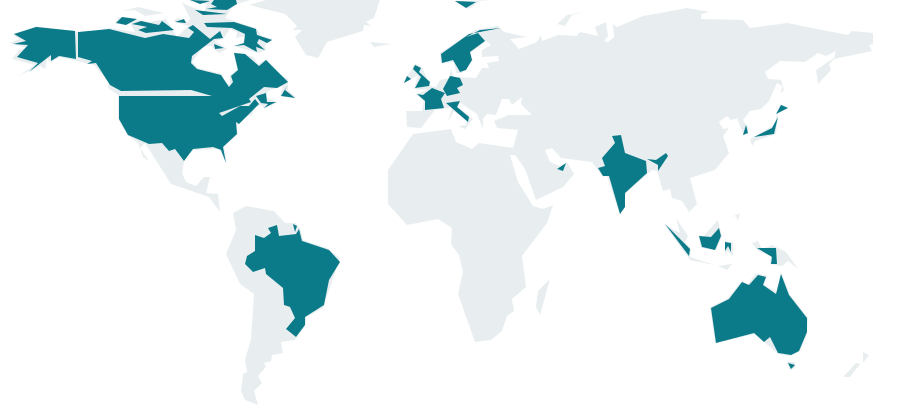
Widening the boundary to include multi-country processing zones raised the count from 19 to 42 countries. The geographical imbalance was striking. None of the 25 low-income countries qualified under the strict rule, compared with 16 of 64 high-income countries. The 19 qualifying countries were home to about 35% of the world's population, with India accounting for a large share.
The buying plan can change the answer
Later supplier documents made the purchasing issue concrete. A model could list national processing under reserved capacity while its ordinary pay-as-you-go menu listed broader regions. Other options depended on customer approval, model eligibility or a price premium. The location promise had to be read alongside the purchase route.
The 31 October follow-up coded 812 public catalogue entries. Applying different purchasing rules to those same entries changed the number of documented country–platform choices.
| Purchasing profile | Countries | Country–platform pairs |
|---|---|---|
| Pay as you go | 19 | 29 |
| Plus approval-based options | 19 | 31 |
| Plus hourly reserved capacity | 22 | 39 |
| Plus fixed-term capacity | 22 | 45 |
A closer price cross-check matched 34 routes to a specific model, location, buying mode and published numeric price. In a common $6,000 monthly-workload scenario, the matching country–platform combinations rose from nine under pay-as-you-go purchasing to fifteen when reserved capacity was permitted.
What the locality tax captures
The locality tax describes the extra cost or conditions attached to choosing where managed AI processes information. It may appear as a smaller choice of models, a narrower processing promise, an additional approval, a capacity reservation or a higher price. These conditions differ across suppliers and models. They also change as services and contract terms change.
A dated record for every locality claim
The Locality Disclosure Matrix brings seven pieces of information into a single dated record. It gives buyers a consistent way to compare supplier promises that are currently spread across model cards, pricing pages and service terms.
| Field | Information to record |
|---|---|
| Storage | Location and retention boundary |
| Inference processing | Prompt and output processing locations, routing exceptions |
| Model and version | Exact model, endpoint and supported locations |
| Purchase route | Pay-as-you-go or reserved mode, approvals and eligibility |
| Price and capacity | Premiums, commitments, quotas and capacity |
| Guarantees | Covered operations and exclusions |
| Dates | Source date, change notice and model retirement |
The proposed decision process begins with a procurement screen, continues through the negotiated contract, and reaches the operational setup. A buyer could compare the advertised option with its own requirements, identify the missing evidence, and revisit the choice when the model, region, contract or capacity changes.
An initial four-supplier pilot tested the proposed record against 28 document fields. Sixteen could be found directly, eight required comparing documents, three were partly confirmed and one price link remained open. The next step is to make the record usable in actual procurement reviews.
Conference record
Presented at the 2026 Yale Global Justice Program Annual Conference on 7 November 2026. The country survey uses the 5 October supplier catalogue; the purchasing comparisons use the 31 October follow-up.